WhatsApp for Healthcare: The 2026 Patient Communication Playbook (India)
Indian clinics lose ₹800–2,500 to every missed appointment, and no-show rates run 25–35%. This 2026 playbook shows how clinics, hospitals and diagnostic labs use WhatsApp for appointment reminders, report delivery, follow-ups and patient support — with the DPDP consent rules and clinical boundaries you must get right first.

On this page
A patient books an appointment and forgets. A lab report sits at reception for four days. A post-surgery follow-up call goes unanswered. A front desk spends its whole morning on the phone confirming tomorrow's slots.
None of this is rare — it's the daily operating reality of most Indian clinics. And with no-show rates in South Asia running 25–35%, and each missed appointment costing a clinic roughly ₹800–2,500 in lost consultation revenue alone, it's expensive.
WhatsApp fixes a large part of it. But healthcare is the one vertical where you need to get the rules right before the tactics. So let's start there.
Start here: the compliance reality
Under India's Digital Personal Data Protection Act, 2023 (DPDP), a patient's health information is personal data that requires specific, informed consent before processing. Practically, for a clinic using WhatsApp, that means:
Get documented opt-in. Collect consent at registration, at booking, on your website form, or via a QR code at reception. Store each opt-in with a timestamp, the channel it came through, and the exact consent wording used.
Be specific about what they're consenting to — appointment reminders, report notifications, follow-ups — and how to opt out.
Respect purpose limitation. This is where clinics most often slip: the number a patient gave you to receive their lab report is not a marketing list. You may only use the data for the purpose the patient agreed to.
Be transparent about what you collect, why, and how consent can be withdrawn.
The DPDP Rules that add operational detail are still phasing in, so the sensible position is to prepare now: clean opt-ins on record, purpose-scoped, and never retrofitted onto data you already hold for a different reason. If you're aligning with ABDM/ABHA, factor that in too.
Most patients consent readily — WhatsApp communication genuinely helps them. But the documentation isn't optional.
The clinical boundary: what WhatsApp should and shouldn't do
This matters as much as consent. A WhatsApp chatbot in a clinic is an administrative tool, not a clinical one.
Appropriate: booking and rescheduling, reminders, directions and timings, doctor availability, department routing, fee and insurance queries, report-ready notifications, form collection, feedback.
Never appropriate: diagnosing, triaging symptoms, interpreting results, advising on medication or dosage, or answering "should I be worried about this?" Any clinical question must escalate to qualified staff, with the full conversation history so the patient doesn't repeat themselves.
And critically: WhatsApp is not an emergency channel. Your automated greeting should say so explicitly, and direct anyone with an emergency to call your emergency number or go to the nearest facility immediately. Messages can go unread for hours — build that assumption into every flow you design.
The playbook
1. Appointment reminders (start here)
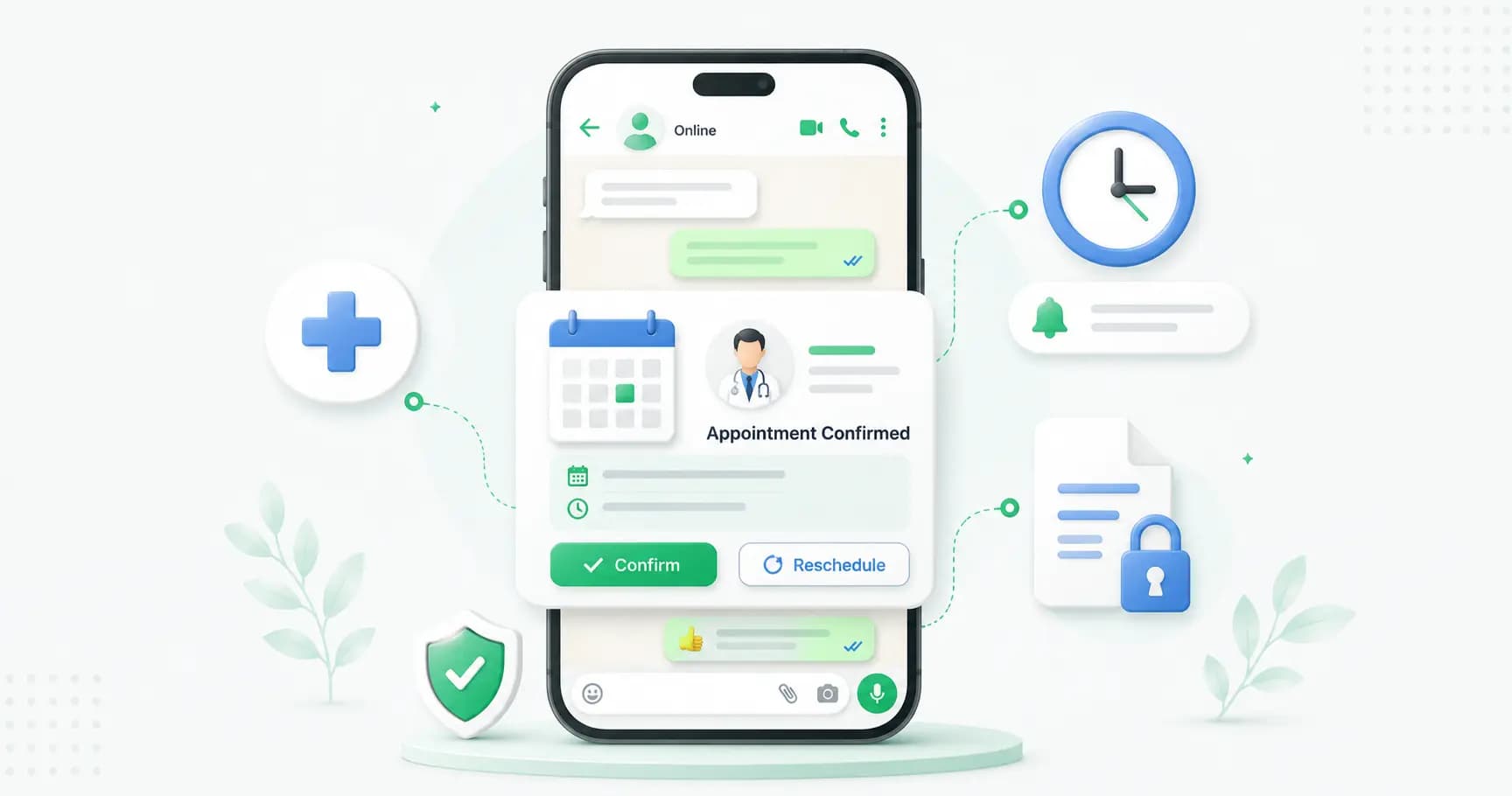
This is the highest-return use case and where every clinic should begin. The pattern that works: a confirmation at booking, a reminder 24 hours before, and a nudge about an hour before. Include one-tap Confirm and Reschedule options so the patient can act without calling.
Confirmations sent 24 hours ahead meaningfully cut no-shows — clinics commonly report reductions in the region of 15–45% depending on their baseline. When someone taps Reschedule, offer the next available slots straight away, so the freed slot gets refilled instead of lost.
Practical tip: roll this out for the next seven days of scheduled patients first. It's a small, contained pilot that shows results within a week.
2. Report and document delivery — the "secure doorbell" pattern
Diagnostic reports are the second big win, and there's a right way to do it.
Send a notification, not the results. The message tells the patient their report is ready and how to access it — it does not contain clinical findings in the message body. Deliver the report itself as a password-protected PDF attachment via a pre-approved utility template, with the password shared through a separate channel.
Patients typically receive results days faster than by post or counter pickup, and uncollected reports effectively disappear as a problem.
3. Booking and rescheduling
Let patients book without calling. A WhatsApp Flow can show departments, doctors and available slots, capture the details you need, and confirm — inside the chat. Your front desk stops being a switchboard.
4. Patient enquiries and routing
An AI assistant can answer the questions that consume your reception's day — timings, location and parking, consultation fees, doctor availability, insurance and empanelment, preparation instructions for tests — and route speciality enquiries to the right department. Anything clinical escalates to a human immediately.
5. Follow-ups and post-discharge care
Post-visit and post-discharge follow-ups are where outcomes and revenue both live. Automate the check-in message, the next-review-date reminder for chronic patients, and medication-course reminders (as reminders to follow their prescribed course — never dosage advice).
6. Prescription refills
For pharmacies and clinics with in-house dispensing, refill reminders are consistently the highest-ROI flow — a timely nudge with a one-tap reorder option. Note that WhatsApp's commerce policies restrict the sale of medical and healthcare products, so treat this as a communication and reorder-request flow, not an in-chat medicine checkout, and check current policy before you build.
7. Payments and insurance status
Send payment links for consultations and packages, receipts on payment, and status updates for insurance pre-authorisation or TPA claims. Keep claim processing in the insurer's portal — WhatsApp is the patient-facing communication layer, not the claims system. (See accepting payments on WhatsApp.)
8. Feedback and reactivation
Satisfaction surveys sent 24–48 hours after a visit get response rates several times higher than email or SMS. And with consent, annual health-check reminders bring lapsed patients back — a far cheaper source of appointments than new acquisition.
Template examples
Appointment confirmation
✅ Appointment confirmed
{{patient_name}}, your appointment with Dr. {{doctor}} ({{department}}) is confirmed for {{date}} at {{time}} at {{clinic_name}}.
Please arrive 10 minutes early and bring any previous reports.
Reply RESCHEDULE to change, or CANCEL to cancel.
24-hour reminder
⏰ Reminder: your appointment with Dr. {{doctor}} is tomorrow, {{date}} at {{time}}.
Tap CONFIRM to keep your slot, or RESCHEDULE if you need another time.
Report ready (no results in the body)
📄 Your report is ready
{{patient_name}}, your {{test_name}} report from {{date}} is now available.
It's attached as a password-protected document. Your password has been shared separately.
For any questions about your results, please contact us to speak with your doctor.
Follow-up check-in
👋 Checking in, {{patient_name}}.
It's been {{days}} days since your visit with Dr. {{doctor}}. How are you feeling?
Reply here and our team will assist. For anything urgent, please call {{phone}}.
Payment link
💳 Payment for your consultation on {{date}}: ₹{{amount}}.
Pay securely here: {{payment_link}} — your receipt will follow automatically.
Best practices
Start with one flow. Appointment reminders for next week's patients. Prove the reduction in no-shows, then expand.
Get template categories right. Reminders, confirmations and report alerts are utility templates — cheap and appropriate. Health-check campaigns and offers are marketing, requiring separate opt-in. Never mislabel one as the other.
Never put clinical information in a message body. Notification in chat, content in a protected document.
Set expectations in your greeting — response hours, and a clear emergency instruction.
Use the patient's language. Hindi, Bengali, Tamil or English — comprehension matters more here than anywhere.
Route replies to a real inbox. A shared inbox with front desk and nursing staff, permissions, and an audit trail.
Don't market to patients who only consented to reminders. It's the fastest way to lose both trust and compliance footing.
Wire it to your EMR or PMS so appointments, reports and reminders flow automatically rather than being copied by hand.
How Splashify Pro fits a clinic
Splashify Pro gives clinics, hospitals and labs the official WhatsApp Business API with automated appointment reminders and one-tap rescheduling, Flows for booking, secure document delivery via utility templates, an AI assistant for administrative enquiries with instant escalation to staff, a shared inbox with role-based permissions, and payment links for consultations. A Voice AI receptionist can also answer calls your front desk misses. INR-native, live in one to two hours.
Compliance is a shared responsibility: no platform makes you compliant on its own. Your consent capture, purpose limitation and internal data handling remain yours to get right.
Frequently asked questions
Is it legal for clinics to use WhatsApp for patient communication in India?
Yes, with proper consent. Under the DPDP Act 2023, patient health information is personal data requiring specific, informed consent before processing. Collect documented opt-in at registration or booking, specify what messages the patient will receive, allow easy withdrawal, and use the data only for the purpose consented to.
Can I send lab reports over WhatsApp?
Yes, when done carefully. Best practice is to send a notification that the report is ready rather than the findings themselves, and deliver the report as a password-protected PDF via a pre-approved utility template, with the password shared separately. Never put clinical results in the message body.
How much do WhatsApp appointment reminders reduce no-shows?
Clinics commonly report meaningful reductions — often in the range of 15–45% depending on their starting no-show rate. The pattern that works is a confirmation at booking, a reminder 24 hours ahead, and a nudge about an hour before, each with one-tap confirm and reschedule options.
Can a chatbot answer patients' medical questions?
No. A clinic chatbot should handle administrative tasks only — booking, reminders, timings, fees, directions, department routing and report notifications. It must never diagnose, triage symptoms, interpret results or advise on medication. Clinical questions should escalate to qualified staff with full conversation history.
Is WhatsApp suitable for medical emergencies?
No. Messages can go unread for hours, so WhatsApp must never be positioned as an emergency channel. State this clearly in your automated greeting and direct anyone with an emergency to call your emergency number or attend the nearest facility immediately.
Do appointment reminders count as marketing messages?
No. Appointment confirmations, reminders and report-ready notifications are utility templates, which are inexpensive and appropriate as responses to a patient action. Health-check campaigns, packages and offers are marketing templates requiring separate explicit opt-in.
Can I use patient phone numbers for marketing campaigns?
Not without separate consent. Under DPDP purpose limitation, a number given to receive test reports cannot be repurposed as a marketing list. If you want to send health-check offers, collect distinct marketing consent for that purpose.
Does my clinic need the WhatsApp Business API?
For a single practitioner handling a handful of appointments, the free WhatsApp Business app may suffice. Any clinic, hospital or lab wanting automated reminders, secure report delivery, EMR integration, or multiple staff working one number needs the API.
This article is general information for Indian healthcare businesses, not legal or medical advice. Verify regulatory specifics against current law and consult your compliance advisor before implementation.
The bottom line
Most of what drains an Indian clinic's day — confirming appointments, chasing follow-ups, handing out reports, answering the same six questions — is administrative work that can run itself on WhatsApp. Done properly, no-shows fall, reports reach patients days sooner, and your front desk gets its mornings back.
Just build it in the right order: consent first, clear clinical boundaries second, automation third. Get that sequence right and WhatsApp becomes the most reliable channel between your clinic and your patients.
Set up patient communication on WhatsApp with Splashify Pro → — appointment reminders, booking flows, secure document delivery and a staff inbox. Free for 14 days.
Related posts
More articles you might find useful.
WhatsApp Business Statistics 2026: 60+ Data Points for India & Global
The most accurate WhatsApp statistics for 2026 — user numbers, business adoption, India-specific data, marketing performance, pricing and AI trends. Every figure sourced, with conflicting estimates flagged rather than copied, so you can cite these numbers with confidence.
WhatsApp for Restaurants: Build Direct Orders & Cut Aggregator Commission (2026)
Swiggy and Zomato take 18–30% of every order. A direct WhatsApp order costs 4–6%. This 2026 playbook shows Indian restaurants and cloud kitchens how to build a direct ordering channel on WhatsApp — capturing customer numbers, automating reorders, taking reservations and running specials — without walking away from the aggregators that bring you discovery.
WhatsApp for Education: The 2026 Admissions & Student Engagement Playbook
Coaching institutes, schools and edtech platforms don't have a lead problem — they have a follow-up problem. This 2026 playbook shows how Indian education businesses use WhatsApp to answer enquiries instantly, book demo classes, nurture parents and students through the decision cycle, collect fees, and fill batches faster.