WhatsApp for Restaurants: Build Direct Orders & Cut Aggregator Commission (2026)
Swiggy and Zomato take 18–30% of every order. A direct WhatsApp order costs 4–6%. This 2026 playbook shows Indian restaurants and cloud kitchens how to build a direct ordering channel on WhatsApp — capturing customer numbers, automating reorders, taking reservations and running specials — without walking away from the aggregators that bring you discovery.

On this page
Every restaurant owner in India has done this arithmetic at 11pm with a reconciliation sheet open. On a ₹500 order, the aggregator takes ₹125–190 once you add commission, ad spend, peak surcharge and discount funding. For a modest kitchen doing 400 orders a month, that's ₹30,000–45,000 gone. At 100 orders a day, platform costs run to roughly ₹4.4 lakh a month.
The same order taken directly costs you 4–6% — payment gateway plus a delivery partner. That gap of 16–20 percentage points is pure margin.
This guide is about closing some of that gap using WhatsApp. It starts with the part most "escape the aggregators" advice gets wrong.
First, the honest advice: don't quit the aggregators
Around 35% of Indian restaurants said in a late-2025 survey they'd leave Zomato and Swiggy tomorrow if they could. Most shouldn't.
Aggregators do something your WhatsApp cannot: they put you in front of people who've never heard of you. They're a discovery engine, and for a new kitchen that's worth paying for. Roughly 25–30% of cloud kitchens fold before their first anniversary, and cutting off your discovery channel to save commission is a fast way to join them.
The strategy that actually works in 2026 is a dual stack: keep the aggregators for reach, and build a direct channel alongside them for the customers who already know you and are ordering again. You're not trying to replace Swiggy. You're trying to stop paying Swiggy 25% for a repeat customer who would have ordered from you anyway.
That's where WhatsApp earns its place.
Why WhatsApp is the right direct channel
Your customers won't download your app. They will message you on WhatsApp — it's already on their phone, it needs no install, and it works for a 55-year-old in a Tier-3 town as easily as a college student in Bengaluru.
More importantly, a WhatsApp order gives you the thing aggregators never will: the customer's phone number and order history. That's the asset. One kitchen owner started noting numbers from day one, built a list of 1,800, and was pushing 22% of orders through direct channels by early 2026.
The realistic benchmark: shifting even 20% of orders to direct on a ₹5 lakh/month kitchen keeps roughly ₹16,000–20,000 every month — about ₹2 lakh a year that stays in your account.
The playbook
1. Capture phone numbers relentlessly
You can't build a direct channel without a list. Capture at every touchpoint:
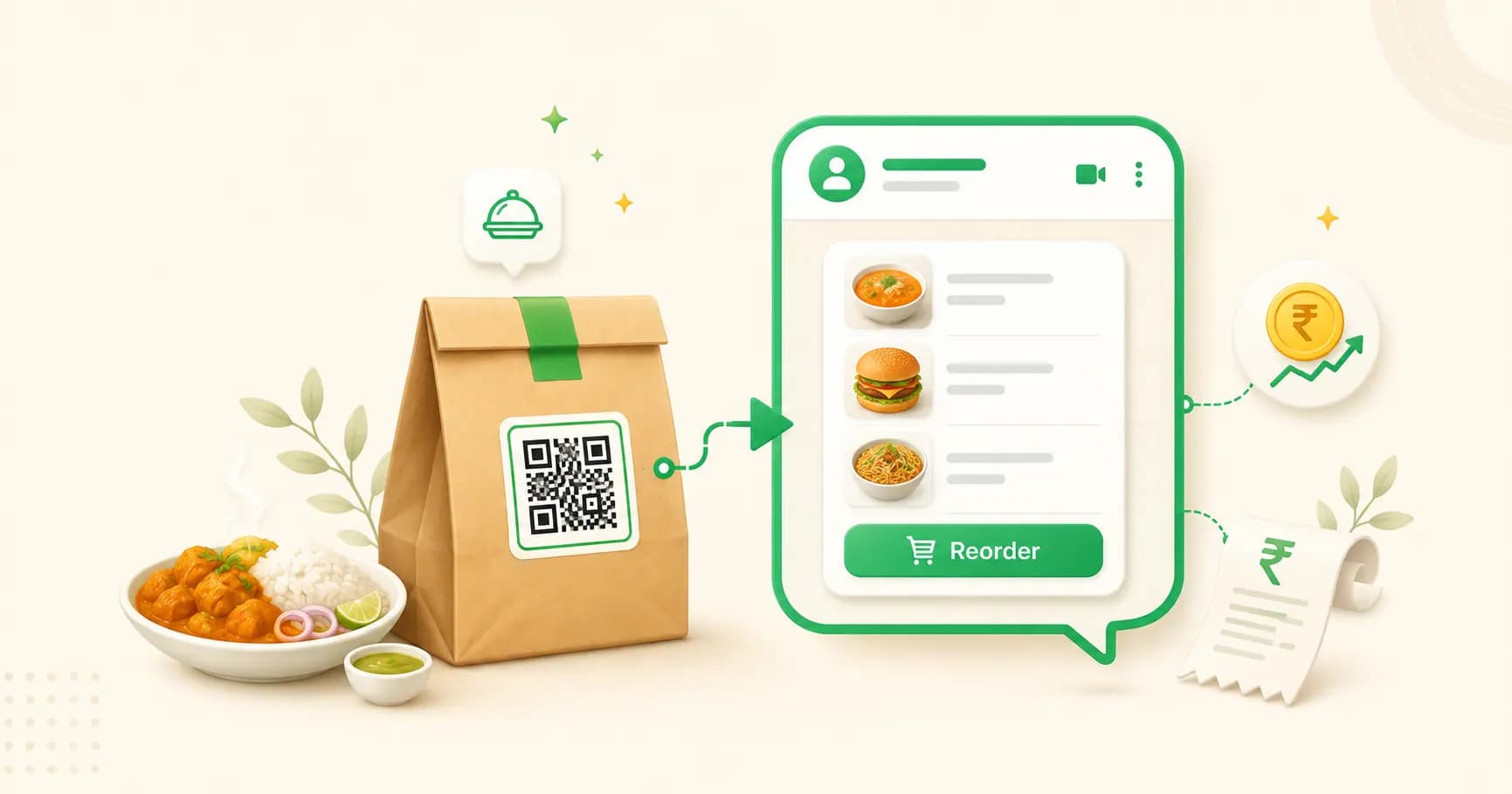
A QR code on every delivery bag and packaging insert — "Order direct next time, 10% off" with a WhatsApp QR code.
Table tents and menu cards for dine-in.
On the bill, with a small incentive to save your number.
Instagram bio and story links — the highest-converting free channel most restaurants underuse.
At the counter, for takeaway customers.
The economics here are absurd in your favour: printing 500 insert cards at about ₹1.50 each costs ₹750. If 15% scan and place one order at ₹500 with a 35% recovered take rate, that's roughly ₹13,000 in incremental margin from a ₹750 spend.
2. Run a WhatsApp ordering line
Let customers order in chat. A catalog shows your menu with photos and prices, an automated flow captures the order and address, and a payment link closes it. No app, no website, no commission. (See how to sell on WhatsApp for catalog setup, and accepting payments for UPI and payment links.)
Keep the menu focused — your top sellers, not all 90 items. Chat browsing rewards brevity.
3. Automate reorders (highest ROI)
This is the single most valuable automation for food. Your customers are habitual: the same biryani, most Fridays. A well-timed reorder nudge with a one-tap "Order the usual" converts extremely well because there's no decision to make.
Trigger it on order history — say, 10–14 days after a customer's last order, at the time of day they usually order. A useful benchmark from operators: a good WhatsApp broadcast should see 4–6% of recipients ordering within 48 hours.
4. Take table reservations
For dine-in, a WhatsApp Flow handles date, time and party size in chat, confirms instantly, and sends a reminder a few hours before — which cuts no-shows on Friday and Saturday tables, where a lost booking is a lost peak slot.
5. Broadcast daily specials and offers
Today's thali, a new dish, weekend combos, a festival menu. Send to opted-in customers segmented by what they actually order — vegetarian customers shouldn't get your kebab platter promo. Keep it to a couple of sends a week; food fatigue is real and blocks are permanent.
6. Send order status updates
Order confirmed, being prepared, out for delivery, delivered. These are cheap utility messages, they reduce "where's my order" calls during your busiest hour, and they make a direct order feel as reliable as an aggregator one — which is the main objection customers have to ordering direct.
7. Collect feedback and reviews
A short message a couple of hours after delivery gets response rates far above email. Route unhappy feedback straight to the manager before it becomes a public review, and ask happy customers for a Google review.
8. Build simple loyalty
Order-count tracking with a reward ("your 10th order is free"), birthday offers, and lapsed-customer win-backs ("haven't seen you in a while — here's 15% off"). No app or card needed; it all lives in the chat.
For cloud kitchens specifically
Cloud kitchens have no walk-in traffic, so the packaging insert is your storefront. A few things that matter more for you:
Every delivery bag must carry the QR — it's your only physical touchpoint with a customer.
Multi-brand operators can run several virtual brands from one WhatsApp number with separate catalogs and flows.
Price your delivery menu 12–18% above dine-in to absorb aggregator cuts — and keep direct pricing attractive by comparison.
Consider ONDC as a third rail. It's live across 600+ cities at roughly 3–5% commission with customer data access — cheaper than aggregators, though you still have to drive demand to it. WhatsApp handles repeat; ONDC and aggregators handle discovery.
Watch your channel mix weekly. Knowing what share of revenue is direct versus aggregator is what tells you whether any of this is working.
Template examples
Order confirmation
✅ Order confirmed, {{name}}!
{{items}} — ₹{{amount}}
🕐 Ready in approximately {{minutes}} minutesWe'll message you when it's out for delivery. Thanks for ordering direct! 🙏
Reorder nudge
👋 Craving the usual, {{name}}?
Your last order: {{last_order}}
Tap below and we'll have it on its way in {{minutes}} minutes — plus ₹{{discount}} off for ordering direct.
🍽️ {{order_link}}
Daily special broadcast
🔥 Today's special at {{restaurant_name}}
{{dish_name}} — ₹{{price}} (usually ₹{{regular_price}})
Available till {{time}} or until we run out. Order direct: {{link}}
Table reservation confirmation
🍽️ Table booked, {{name}}!
{{party_size}} guests on {{date}} at {{time}}.
Reply RESCHEDULE if plans change — we'll hold your table for 15 minutes past the booking time.
Direct-order incentive (on packaging QR)
🎉 Thanks for ordering, {{name}}!
Order direct with us next time and get {{discount}}% off — no app needed, just message us here.
Save this chat and you're set. 😊
Win-back
😔 We've missed you, {{name}}!
It's been a while since your last {{favourite_dish}}. Here's {{discount}}% off to tempt you back.
{{link}} · Valid till {{date}}
Best practices (and what not to do)
Never badmouth the aggregators in customer messaging. Just make ordering direct easier and slightly cheaper.
Give a real reason to switch — a discount, free delivery, a free add-on. "Order direct to help us" doesn't move anyone.
Don't over-broadcast. Two well-targeted sends a week beats daily specials nobody asked for.
Only message opted-in customers. Scraping numbers from aggregator orders and blasting them is both a policy violation and a fast route to a banned number.
Answer fast during service. If a customer messages at 8:30pm and hears back at 10, you've lost the order. Automate the first reply and order flow.
Match aggregator reliability. Clear timings, live status updates and a real person for problems. Customers order direct when it doesn't feel like a downgrade.
Keep a 5km delivery radius as a starting point — beyond that, food quality and delivery economics both suffer.
How Splashify Pro helps restaurants
Splashify Pro gives you the direct channel without building anything: a WhatsApp catalog and ordering flow, UPI and payment links via Razorpay, PhonePe, PayU and Cashfree, automated order status updates, reorder and win-back campaigns segmented by order history, reservation flows with reminders, and an AI assistant handling enquiries during your dinner rush. Add Instagram automation to convert social followers into direct orders, and a Voice AI receptionist to catch calls when your counter is slammed. INR-native from ₹899/month.
Frequently asked questions
How much commission do Swiggy and Zomato charge in 2026?
Base commissions run roughly 18–30% depending on city, cuisine and negotiated rate, and the real deduction is higher once ad spend, peak surcharges, payment fees and discount funding stack up. On a ₹500 order, restaurants commonly report ₹125–190 going to the platform.
How much cheaper is a direct WhatsApp order?
Substantially. A direct order typically costs 4–6% — payment gateway plus a third-party delivery charge — versus 18–30% on an aggregator. Shifting 20% of orders to direct on a ₹5 lakh/month kitchen keeps roughly ₹16,000–20,000 a month, about ₹2 lakh a year.
Should I stop using Swiggy and Zomato?
For most restaurants, no. Aggregators provide discovery you can't replicate — they put you in front of people who've never heard of you. The proven approach is a dual stack: keep aggregators for new customers, and use WhatsApp to own repeat orders where you're otherwise paying 25% commission on business you'd get anyway.
How do I get customers to order directly on WhatsApp?
Capture numbers everywhere — QR codes on packaging and delivery bags, table tents, bills, your Instagram bio and at the counter — and give a genuine incentive to switch, such as a discount or free delivery. Then make ordering easy with a chat catalog, a payment link and automatic order updates.
Can I take restaurant orders and payments inside WhatsApp?
Yes. A catalog shows your menu, an automated flow captures the order and address, and a UPI or payment link closes it in the chat. You'll need the WhatsApp Business API through a platform to automate this properly.
Can I message customers I got from Swiggy or Zomato orders?
Not without their consent. Using numbers from aggregator orders to send marketing messages breaches platform policies and WhatsApp's opt-in rules, and risks getting your number banned. Instead, invite those customers to opt in via a QR code or insert card in their delivery.
How often should I send WhatsApp offers to customers?
Around twice a week is a sensible ceiling for most restaurants, targeted by what customers actually order. A useful benchmark is that a good broadcast sees 4–6% of recipients ordering within 48 hours — if you're well below that, you're sending too often or to the wrong segment.
Does this work for cloud kitchens without dine-in?
Yes, and packaging becomes critical since it's your only physical touchpoint. Put a QR code on every delivery bag with a direct-order incentive, then use reorder automation on order history — repeat ordering is where cloud kitchen margin lives.
The bottom line
You're not going to escape the aggregators, and you shouldn't try. But you're almost certainly paying 25% commission on customers who already know your food, already like it, and would happily order again through a channel that costs you 5%.
Capture their numbers, make reordering effortless, and let the aggregators keep doing what they're actually good at: finding you new people. Shift a fifth of your orders and you've added a couple of lakh a year to your bottom line without selling a single extra plate.
Build your direct WhatsApp ordering channel with Splashify Pro → — chat menu, payments, order updates and reorder automation. No app needed, free for 14 days.
Related posts
More articles you might find useful.
WhatsApp Business Statistics 2026: 60+ Data Points for India & Global
The most accurate WhatsApp statistics for 2026 — user numbers, business adoption, India-specific data, marketing performance, pricing and AI trends. Every figure sourced, with conflicting estimates flagged rather than copied, so you can cite these numbers with confidence.
WhatsApp for Healthcare: The 2026 Patient Communication Playbook (India)
Indian clinics lose ₹800–2,500 to every missed appointment, and no-show rates run 25–35%. This 2026 playbook shows how clinics, hospitals and diagnostic labs use WhatsApp for appointment reminders, report delivery, follow-ups and patient support — with the DPDP consent rules and clinical boundaries you must get right first.
WhatsApp for Education: The 2026 Admissions & Student Engagement Playbook
Coaching institutes, schools and edtech platforms don't have a lead problem — they have a follow-up problem. This 2026 playbook shows how Indian education businesses use WhatsApp to answer enquiries instantly, book demo classes, nurture parents and students through the decision cycle, collect fees, and fill batches faster.